
The Delivery Gap Killing Australian Dropshipping Sales
Oct 12, 2026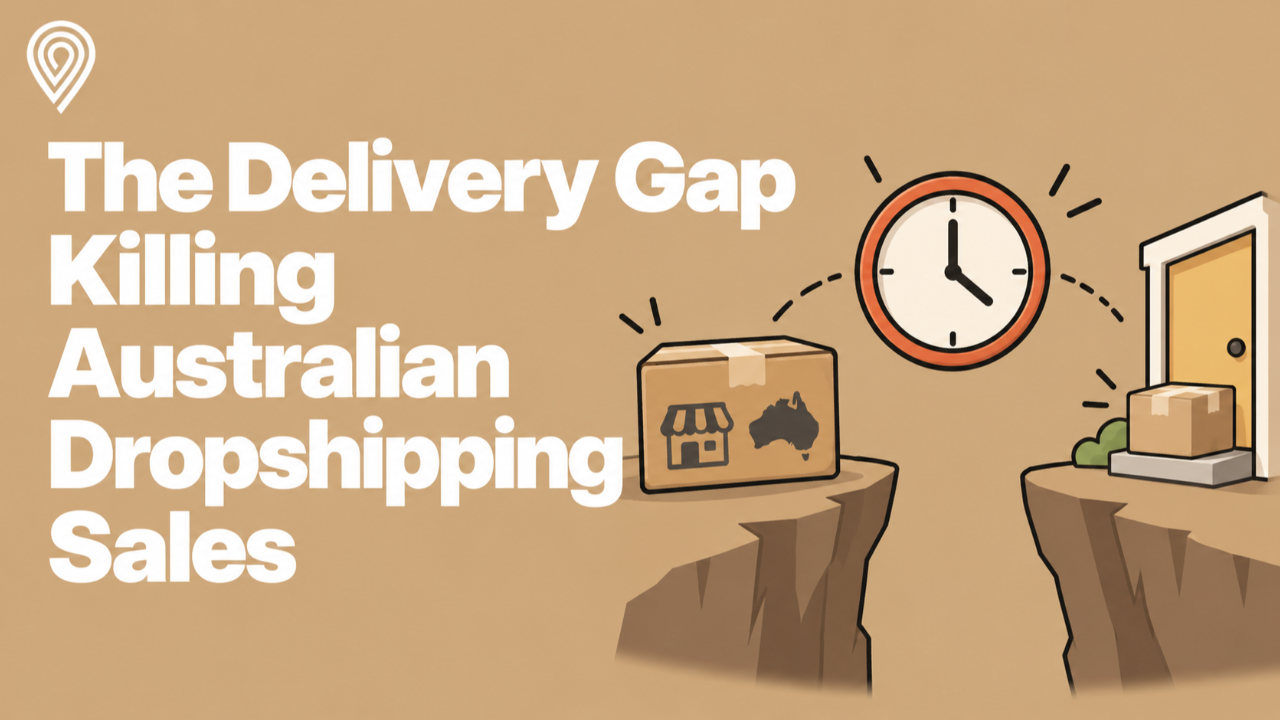
The Delivery Gap Killing Australian Dropshipping Sales
A customer can love your product, like the price, trust the website and still never buy from you again.
Sometimes, they will not even give you the first sale.
The reason is usually not the product itself. It is delivery.
Australian shoppers have become much more demanding about when an order will arrive, how clearly it is tracked and whether someone takes ownership when something goes wrong. They have been trained by Amazon, major retailers, food-delivery apps and marketplaces to expect regular updates and clear answers.
That creates a serious challenge for dropshipping stores.
A lot of store owners still treat delivery as a small section hidden in the footer. They put most of their energy into product research, ads, Shopify themes and discounts. Then a customer buys, the supplier takes three days to process the order, tracking does not move for another two days, and suddenly the customer is emailing:
Where is my order?
That one question is often the beginning of a refund, a chargeback, a bad review or a customer who never comes back.
The good news is that delivery does not have to be perfect to be good.
You do not need a warehouse full of stock or same-day shipping across Australia. You do need an honest delivery promise, reliable supplier information, clear customer updates and a system that reacts before the customer gets frustrated.
Delivery Is No Longer Just an Operations Issue
For years, ecommerce businesses treated delivery as something that happened after the sale.
The marketing team brought in the customer. The website converted them. The supplier or warehouse handled the parcel. Customer service cleaned up any problems later.
That approach no longer works.
Delivery has become part of the buying decision.
Australia Post’s 2026 ecommerce research found that 73% of shoppers say a good delivery experience makes them more likely to shop online. It also found that 69% want a range of delivery options at checkout, including options such as collection points, Parcel Lockers and easier returns.
That does not mean every dropshipping store has to offer every possible delivery method.
It means customers care about the experience before they hand over their money.
They want to know:
-
Where is the product coming from?
-
How long will it take to dispatch?
-
How long will delivery take after dispatch?
-
Will I get tracking?
-
Is delivery different for regional areas?
-
What happens if the item is delayed?
-
Can I contact someone if it does not arrive?
If your store cannot answer those questions clearly, the customer starts to hesitate.
That hesitation is expensive.
It can lower conversion rates, make paid ads less profitable and create more support work after the sale. It also makes a smaller store look less trustworthy than the big marketplaces customers already know.
“Where Is My Order?” Usually Means More Than That
When a customer asks where their order is, they are not always asking for a tracking number.
Often, they are really asking:
Did I make a mistake buying from this store?
That is the emotional part of delivery that many dropshippers miss.
If a customer has paid A$120 for a product and hears nothing for five days, they do not know what is happening behind the scenes. They do not know whether the supplier has packed it, whether stock is available, whether the courier has collected it or whether the store has forgotten about them.
Silence makes people assume the worst.
It does not matter that your supplier has a normal processing time of three business days if the customer was never told that. It does not matter that the parcel is technically moving if the tracking page looks confusing or has not updated. It does not matter that the delay was caused by a courier if nobody explains it.
The customer bought from your store.
They expect your store to know what is happening.
This is especially important for dropshipping because there is often a gap between the customer placing the order and the product actually being handed to a carrier. That gap can include supplier processing, stock checks, warehouse picking, packing, label creation and courier collection.
A tracking number alone does not solve the problem.
Customers have learned that a tracking number can sit on “label created” for days. They want to see movement. More importantly, they want someone to tell them what to expect before they feel the need to chase it.
The Delivery Problem Starts Before Checkout
Most delivery problems begin before the customer even buys.
They start with vague wording.
A product page says “Free Shipping Australia-Wide.”
Another says “Fast Shipping.”
Another says “Delivered in 5–10 days.”
The issue is that none of those statements tell the customer what actually happens.
Does the item ship from Melbourne, Sydney, China, the United States or multiple warehouses? Is the 5–10 day estimate business days or calendar days? Does that include the time the supplier takes to process the order? Is it realistic for regional Western Australia, Far North Queensland or remote areas?
The more vague the promise, the more likely it is to disappoint someone.
A better product page is specific without becoming overwhelming.
For example:
This item ships from our Melbourne fulfilment partner. Orders are usually dispatched within 1–2 business days. Metro delivery is typically 2–5 business days, while regional delivery may take longer. Tracking is sent once your parcel has been collected by the carrier.
That is simple. It is useful. It sets a realistic expectation.
If the item ships from overseas, say that too:
This item ships from our international warehouse. Please allow 2–4 business days for processing and approximately 8–14 business days for delivery to Australia. Tracking will be sent once your order has been dispatched.
Some people will decide not to buy because of the delivery time.
That is okay.
It is better to lose a customer before checkout than gain a customer who feels misled after paying.
The wrong type of sale creates refunds, support tickets and stress. The right customer is happy to wait when they understand exactly what they are waiting for.
Local Stock Helps, But It Is Not the Whole Answer
Local Australian stock can be a major advantage.
It can mean faster delivery, simpler returns, easier supplier communication and a more believable customer experience. In many niches, it gives a smaller store a real point of difference against offshore marketplaces.
But local stock is not automatically a winning strategy.
A product can ship from Australia and still create a terrible customer experience if it takes five days to dispatch, tracking is unreliable, the supplier is unresponsive or the product arrives damaged.
At the same time, an overseas product can still work if the store is upfront about delivery time, keeps the customer informed and offers something worth waiting for.
The real advantage is not simply local stock.
It is certainty.
Customers want to know what will happen after they buy.
They want to know whether the store has control over the process. They want confidence that if something goes wrong, there is a person behind the website who will sort it out.
That is why “Australian owned” and “ships from Australia” should never be used as if they mean the same thing.
They do not.
If you are Australian owned but the product ships from overseas, be proud of the business but be clear about fulfilment. If the product is genuinely stocked and dispatched locally, explain the real benefit without exaggerating it.
Trust comes from being precise.
Slow Delivery Is Not Always the Problem. Unclear Delivery Is.
Customers will wait for products when the reason makes sense.
People wait weeks for custom furniture, personalised gifts, made-to-order clothing, imported hobby products and specialist equipment. They wait because they understand why the product takes time.
What they do not accept is a store pretending that a long process is fast.
A dropshipping store gets into trouble when it uses language designed to improve conversion rather than language designed to set the right expectation.
“Fast shipping” might get more clicks.
But if the product takes three business days to process and another 12 business days to arrive, the customer will remember the gap between what they expected and what happened.
That gap is where trust disappears.
A delivery promise should include four things:
-
Processing time
-
Transit time
-
Delivery location or origin
-
What happens if the order is delayed
The first two are different.
Processing is the time between the customer paying and the supplier handing the item to the carrier. Transit is the time the carrier takes to move the parcel.
Most stores only talk about transit time. That is why customers feel confused when nothing appears to happen after they order.
If processing takes two days, say two days.
If a supplier only dispatches on weekdays, say so.
If the product is made to order, say so.
If some postcodes take longer, say so.
You are not making the offer weaker. You are making it believable.
One Delayed Order Can Cost More Than the Order Value
A delayed order is rarely just one delayed order.
It can create a chain reaction.
The customer may email customer service. Your team then needs to check Shopify, contact the supplier, wait for a response, review tracking and update the customer. If the customer becomes frustrated, they may request a refund. If the product has already been dispatched, you might be paying supplier costs, shipping costs and refund costs at the same time.
If the customer contacts their bank instead, you may face a chargeback.
If they leave a negative review, future customers see it. If they post on social media, you spend time managing a reputation problem that started with a simple lack of communication.
This is why delivery is not something to “deal with later.”
It affects the economics of the business.
A product with a slightly lower margin but reliable local fulfilment may be more profitable than a higher-margin product that constantly creates delivery problems. A supplier that charges a little more but responds quickly and provides accurate tracking can be worth far more than the cheapest supplier in the catalogue.
The cheapest product is not always the most profitable product.
The same is true for shipping.
Offering free shipping can increase conversion, but only if the product price and margin can carry it. If shipping becomes expensive for regional areas, bulky products or multiple-item orders, you need to know that before the customer gets to checkout.
Do not hide difficult freight costs and hope the order is profitable.
Build the delivery cost into the offer properly, set clear rules and make sure the product still works after every cost is included.
Build a Delivery Promise You Can Actually Keep
The best delivery promise is not the fastest one.
It is the one you can meet consistently.
Start by collecting real information from your suppliers.
For every important product, find out:
-
Where it ships from
-
Normal processing time
-
Carrier used
-
Typical metro delivery range
-
Typical regional delivery range
-
Tracking process
-
Stock availability process
-
Return address
-
Escalation contact for delays or missing orders
Do not accept vague answers such as “usually quick” or “normally 5–10 days.”
You need enough clarity to explain the order journey to your customer.
Then test the process yourself.
Order priority products to a metro address and, if possible, a regional address. Record how long it takes for the supplier to accept the order, when tracking first appears, when the carrier actually scans the parcel and when it arrives.
Look at the packaging. Check whether the product matches the listing. See what the customer sees.
That test order can tell you more than a supplier’s entire sales pitch.
It also gives you the chance to create original product photos, videos and delivery-based content for your store.
Once you know the real timing, create delivery messaging that matches it.
Do not use one site-wide shipping statement for every product if products come from different suppliers or locations. A locally stocked item and an international item should not carry the same promise.
Customers do not mind different delivery windows. They mind being surprised by them.
The Post-Purchase Experience Must Not Go Silent
The easiest way to make delivery feel worse is to go quiet after the payment confirmation.
A customer should receive clear communication at the key points of the order.
The first email should confirm the order and remind them of the expected delivery window. If it normally takes two business days for tracking to appear, tell them that.
The second message should confirm dispatch and include tracking once the carrier has collected the parcel.
The third message should be an exception update if something goes wrong.
This is where most stores fail.
They wait until the customer complains. Then they scramble to get an answer from the supplier.
A better approach is to set an internal rule. If tracking has not updated by a certain day, someone checks it. If the order has gone beyond the delivery promise, the customer receives an update before they need to ask.
That email can be simple:
Hi [Name],
Just a quick update on your order. Your delivery is taking longer than expected, and we are checking this with the carrier and fulfilment team now. We will update you again by [specific day]. If we cannot confirm movement by then, we will give you clear options rather than leave you waiting.
That is much better than silence.
It shows the customer that you know there is a problem, you are taking action and you are not hoping they forget about it.
Your Supplier Is Part of Your Customer Experience
In dropshipping, the supplier is not just a product source.
They are part of your brand.
If they dispatch late, your brand looks late.
If they send the wrong item, your brand looks careless.
If their tracking is unreliable, your brand looks suspicious.
If they cannot handle returns, your brand looks difficult.
That means you should not promote every product from every supplier equally.
Create a shortlist of suppliers you trust. Start with a small number of products. Test their fulfilment. Monitor delivery time. Keep records of issues. Pause products that repeatedly create customer complaints.
A large catalogue looks impressive, but it can become a liability if you do not know which products are actually reliable.
A smaller range of well-managed products is easier to market, easier to support and much easier to build a reputation around.
As the business grows, you can add more products. But add them because they fit the customer and the supplier can deliver them properly — not simply because they appear in an app.
A Simple Seven-Day Delivery Reset
If delivery is currently one of the weaker parts of your store, do not try to fix everything at once.
Start with your top-selling and most-advertised products.
On day one, list where each product actually ships from.
On day two, contact suppliers and confirm their real processing time, carriers, tracking method and returns process.
On day three, rewrite the delivery information on your most important product pages.
On day four, compare your product pages, shipping policy and checkout settings. Make sure they do not contradict each other.
On day five, update your order confirmation and tracking emails so customers know what to expect.
On day six, review recent orders and identify where customers were left waiting without an update.
On day seven, create a clear escalation rule for delayed orders.
For example:
If there is no meaningful tracking movement within three business days of dispatch, contact the supplier. If there is still no update within 24 hours, update the customer. If the order goes beyond the promised delivery window, offer a clear resolution.
That process will not eliminate every delay.
It will stop delays from becoming chaos.
Final Thoughts
The delivery gap is one of the biggest reasons promising dropshipping stores lose customers.
Not because every supplier is bad. Not because Australian customers expect impossible delivery speeds. And not because a smaller store cannot compete with Amazon or Temu.
The problem is usually that the customer was promised one experience and received another.
A strong dropshipping store does not hide delivery. It uses delivery as part of the offer.
It tells the truth before checkout. It chooses suppliers carefully. It communicates after the sale. It notices problems early. And when something goes wrong, it takes ownership.
Customers do not need perfection.
They need to feel that somebody has their order under control.
OPPORTUNITY ALERT
Ready to get started with your own drop shipping business? Check out all the Australian "Done For You" dropship stores on our marketplace! They are completely set up, optimised, have great reliable Aussie suppliers in place and are 100% ready to start advertising.
