
Why One Hero Product Beats a 500-Product Store
Nov 09, 2026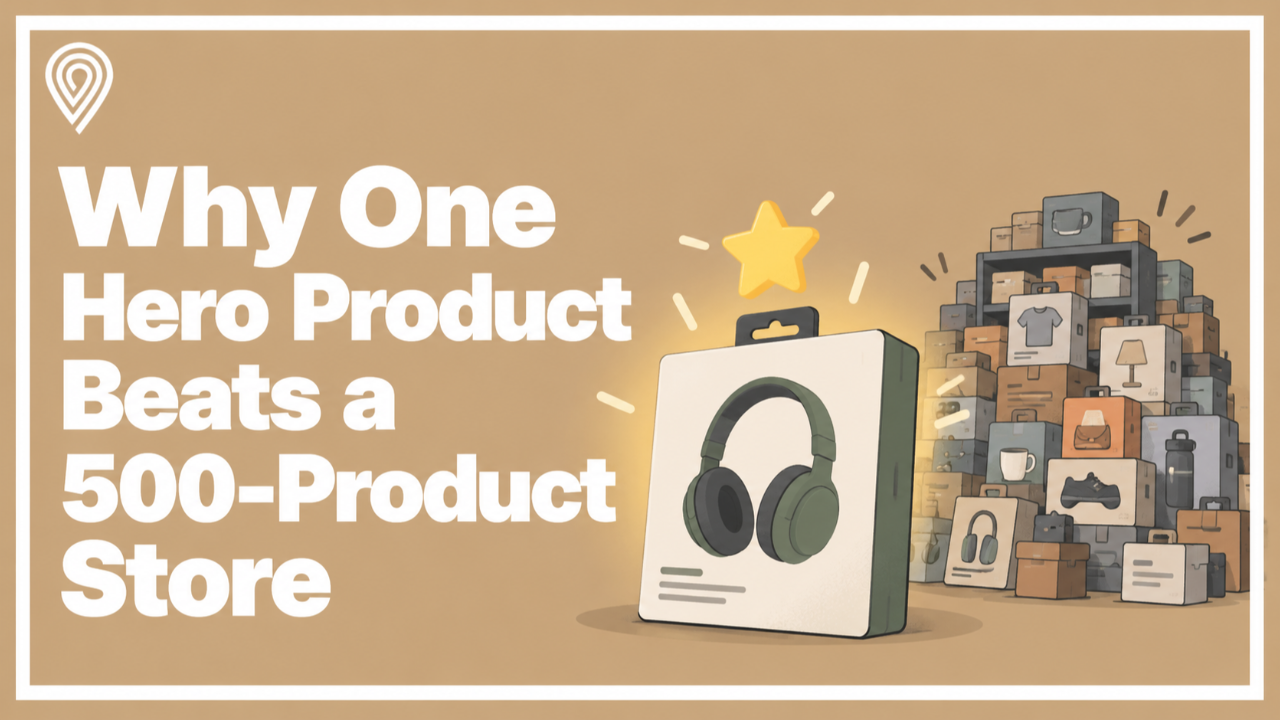
Why One Hero Product Beats a 500-Product Store
The fastest way to make a dropshipping store feel like a real business is not adding more products.
It is choosing one product that gives people a reason to stop, watch, click and buy.
New store owners often launch with 200, 500 or even 2,000 products because it feels safer. More products must mean more chances to make money, right?
Usually, it creates the opposite problem.
The homepage becomes a catalogue. The ads become generic. The social media content has no real direction. A customer lands on the site, sees twenty random categories and has no idea what the business is actually known for.
A hero product changes that.
It gives the business a face. It gives your marketing one clear job. It gives customers something to remember. And it gives you a far better chance of building momentum instead of spreading yourself thin across a hundred average ideas.
This does not mean you can never sell more than one product. It means one product should lead the conversation.
If someone asked, “What does your store sell?” you should be able to answer in one sentence without sounding like a department store.
That is the power of a hero product.
The Store With 500 Products Has a Hidden Problem
A huge product catalogue looks impressive from the owner’s side of the screen. It feels like effort. It feels like progress. It feels as though there must be something for everyone.
But from the customer’s side, it often feels messy.
Think about a small online store selling phone accessories, pet beds, solar lights, yoga mats, coffee grinders and random kitchen gadgets. Even if every product is good, the store does not stand for anything. There is no story. No reason to trust it over a giant marketplace.
Now think about a store built around one genuinely useful product for dog owners who travel in the car. The homepage shows the problem. The product solves it. The supporting products make sense. The videos are easy to imagine. The customer immediately knows they are in the right place.
That second store is easier to market because it is easier to understand.
A hero-product strategy gives you focus in four important places:
-
Your ads have one clear message.
-
Your content has one clear subject.
-
Your product page gets all of your attention.
-
Your customer feedback tells you exactly what to improve.
When you try to sell everything, every decision becomes harder. Which product should you advertise? Which problem should your content solve? Which audience should you target? Which offer deserves your best creative?
With one hero product, the business starts answering those questions for you.
You can still have related products around it. In fact, you should. But those products should support the main sale, increase the cart value or make the customer’s experience better. They should not turn your store into a random warehouse.
A Hero Product Gives Your Ads a Job
The best ads do not try to explain an entire store.
They sell one idea.
That is why one-product and hero-product stores work so well with short-form video, paid social and creator-style content. A person can understand the product in seconds. They see the problem, see the solution and decide whether it matters to them.
A weak ad says:
“Shop our latest collection. Great products at great prices.”
It could belong to almost any store.
A strong ad says:
“If your dog destroys the back seat every time you go to the beach, watch this.”
Or:
“This is the storage fix every apartment kitchen needs.”
Or:
“I bought this because my charging cables were taking over my entire bag.”
The difference is huge. The second version gives the viewer a reason to pay attention before they even know what the product is.
Your hero product becomes the centre of a marketing system:
-
The ad introduces the problem.
-
The video demonstrates the result.
-
The product page answers the questions.
-
The email follow-up brings back the hesitant buyer.
-
The bundle increases the order value.
-
The review creates social proof for the next customer.
Everything connects.
That is much harder to do when your store is trying to market thirty unrelated products at once.
The early goal is not to create a massive ecommerce empire overnight. The early goal is to find one offer you can explain better than your competitors.
The Product Needs a Story, Not Just Margin
A good margin matters. But a good margin alone does not make a great product.
If it did, every high-margin gadget would sell itself.
The strongest hero products usually have three things going for them:
They solve a visible problem.
They are easy to demonstrate.
They create a small emotional reaction.
The problem does not have to be life-changing. In fact, many successful products solve annoyances rather than emergencies.
A tangled mess of cables.
A pet hair problem.
A cramped kitchen bench.
A boring workout routine.
A difficult-to-pack suitcase.
A car that constantly gets messy.
A daily task that takes longer than it should.
The product should make the customer think, “That would make my life easier.”
Then it needs a story.
A story is not something fictional. It is the context that makes a product matter.
A folding storage solution can be positioned as “more storage.” That is boring.
Or it can be positioned as the quick fix for renters who want their home to feel organised without drilling holes or buying expensive furniture. Suddenly, there is a customer, a frustration and a reason to act.
A hero product should fit naturally into a customer’s life. You should be able to make ten different videos without running out of ideas.
Before listing a product, ask yourself:
-
Can I show the problem clearly in a five-second video?
-
Does the product create a noticeable before-and-after?
-
Is there a customer group I can describe in one sentence?
-
Does it lend itself to a bundle or repeat purchase?
-
Would someone send this to a friend and say, “You need this”?
If the answer is yes to most of those questions, it may be worth testing.
Build the Store Around the Yes
Once you choose a hero product, your website should make saying yes feel easy.
Do not force customers to hunt around for the important information. The product page should do the heavy lifting.
Start with the first screen a customer sees on mobile. It should quickly explain what the product does and who it is for. Use an image or video that shows the product in action, not just floating against a white background.
Your headline should describe the outcome, not the technical specification.
Instead of:
“Premium Multi-Use Organiser With Adjustable Compartments”
Try:
“Turn One Messy Drawer Into an Organised Morning”
Instead of:
“Portable Pet Seat Cover With Waterproof Lining”
Try:
“Keep the Car Clean After Every Dog Adventure”
The product details still matter. Put them further down the page for people who need them. But lead with the reason to care.
A strong hero-product page usually includes:
-
A clear benefit-led headline.
-
A short product demonstration.
-
Real images showing size and use.
-
A simple explanation of how it works.
-
Helpful answers to common questions.
-
Reviews or customer feedback as it becomes available.
-
An offer that feels easy to understand.
-
A visible add-to-cart button throughout the page.
Do not bury the best part of the product under a long list of bland features.
The customer should be able to skim the page and still understand why they want it.
The Upsell Is Where Profit Gets Interesting
A hero product gets the sale. A smart offer makes the sale worth more.
Australia Post’s latest ecommerce research shows Australians are shopping online frequently but paying close attention to value. That is a useful reminder: customers are not always looking for the lowest price. They are looking for a purchase that feels worthwhile.
This is where bundles can become powerful.
If your hero product solves a particular problem, think about what else helps solve that problem. The add-on should make the main item more useful, not feel like a random extra.
For example:
A travel organiser could be bundled with a compact toiletry pouch.
A pet car-seat cover could be paired with a portable water bowl or dog travel leash.
A desk organiser could be bundled with cable clips or a small charging station.
A home fitness product could be offered with a simple accessory that makes it easier to use.
The best bundle is not “buy more stuff.” It is “get the full solution.”
You can also use quantity offers where they make sense. Products that are useful in more than one room, car or bag often work well with a two-pack or family pack.
The key is to protect the customer’s confidence. Do not create a fake maze of discounts. Keep the offer simple enough to understand in seconds.
A good structure might be:
Buy one for yourself.
Save more with two.
Get the complete set for the best value.
That gives the customer a choice without making the checkout complicated.
Content Becomes Easier When the Product Is the Brand
One of the biggest benefits of a hero product is that it makes content creation much less intimidating.
You do not need to wake up every day wondering what to post. You already know the subject.
Your job is simply to find new ways to show the product in the customer’s world.
One product can produce dozens of content angles:
-
The frustrating problem it solves.
-
A quick before-and-after.
-
A customer-style unboxing.
-
A gift idea.
-
A comparison with the old way of doing things.
-
A “three reasons I use this every day” video.
-
A reaction video.
-
A common mistake the product helps avoid.
-
A specific use case for a niche customer.
-
A founder-style video explaining why you chose to sell it.
This is why some apparently simple products build strong brands. The product is not always revolutionary. The message is simply focused and repeatable.
Do not make every post look like an ad.
Some of the best content looks like a person sharing a discovery. It feels useful, casual and believable.
Start videos with the moment before the solution:
“I was sick of this happening every time I opened the cupboard.”
“If you have a dog and a car, you know exactly why I bought this.”
“I did not think this would make much difference, but…”
Those openings work because they create curiosity. The viewer wants to see what happens next.
You are not just selling a product. You are selling the feeling of having one less annoying thing to deal with.
How to Know When You Have a Winner
A winning product does not always announce itself with a flood of sales on day one.
Sometimes the first sign is comments.
People ask where to get it.
They tag a friend.
They say they need one.
They ask whether it works for their own situation.
They save the video.
They click through even before the store is fully refined.
Those are signals.
The strongest early signal is not necessarily revenue. It is specific interest.
If people simply write “nice” or “cool,” the product may be entertaining but not commercially strong.
If people ask, “Will this work in a Toyota Prado?” or “Is it big enough for a Labrador?” or “Can I use this in a rental?” you have something much more valuable. You have a customer thinking about themselves using the product.
That is buying intent.
Watch what happens once people land on the site too.
If customers are clicking but not adding to cart, the offer may be unclear.
If they add to cart but do not buy, look at trust, delivery information, price, payment options and checkout friction.
If they buy but do not respond to follow-up offers, the product may have no natural second sale.
The goal is not to panic over every number. It is to look for the one part of the journey that needs improving.
Entrepreneurs lose a lot of money when they either give up too soon or spend too long trying to save an idea that has no real interest. The answer is not emotion. It is testing.
The Seven-Day Hero Product Test
You do not need six months to know whether a product deserves more attention.
Give yourself a focused seven-day test.
Day 1: Build one strong product page. Do not rush the product information, images or offer. Make sure the page clearly answers what the product does and why it matters.
Day 2: Create five short videos around five different hooks. One should focus on the problem. One should focus on the result. One should be customer-style. One should be gift-focused. One should be specific to a clear customer type.
Day 3: Post the videos organically. Watch how people react. Do not just look at views. Look at profile visits, comments, saves, clicks and questions.
Day 4: Rewrite your product headline using the best-performing content angle. If people clearly care about convenience more than style, lead with convenience.
Day 5: Run a small paid test on the best creative. Keep it controlled. You are buying information, not trying to force a winner.
Day 6: Check the full customer journey. Watch how the ad, product page, cart and checkout work on mobile. Fix anything that feels confusing.
Day 7: Decide what deserves another week. If the product is getting interest, improve and test again. If it is getting no real response after genuine effort, move on with the knowledge you gained.
This process is far more useful than adding another fifty products to the store.
What to Do When It Starts Working
When you find a product that begins getting traction, resist the urge to immediately launch ten more random products.
Go deeper first.
Create more content around the winning message. Improve the product page. Add better images. Build a useful bundle. Collect reviews. Test new audiences. Create an email sequence for people who clicked but did not buy.
Then look for ways to extend the product naturally.
Could you add a premium version?
Could you introduce an accessory?
Could you create a gift pack?
Could you build a second product that solves the next problem the customer has?
That is how a hero product becomes a real brand.
A winning product gives you permission to specialise. And specialisation often feels more trustworthy than trying to look like a gigantic retailer from day one.
The store starts building a reputation. Customers know what you are about. Your marketing gets sharper. Your content becomes faster to create. Your paid advertising has more data to learn from.
Momentum compounds when the business is focused.
Final Thoughts
A hero product is not a shortcut to instant riches. It is something better: a simple way to make smarter decisions.
Instead of trying to sell everything, you learn how to sell one thing well.
Instead of creating generic content, you create a message for a real customer.
Instead of endlessly changing products, you get close enough to the market to understand what people actually want.
Start with one clear problem. Find a product that makes the solution easy to see. Build an offer around it. Test the message. Listen to customers. Improve what is already getting attention.
That is how a small dropshipping store stops feeling like an experiment and starts becoming a business.
OPPORTUNITY ALERT
Ready to get started with your own drop shipping business? Check out all the Australian "Done For You" dropship stores on our marketplace! They are completely set up, optimised, have great reliable Aussie suppliers in place and are 100% ready to start advertising.
