
Your Supplier Says It’s In Stock. Your Customer Says Otherwise.
Oct 19, 2026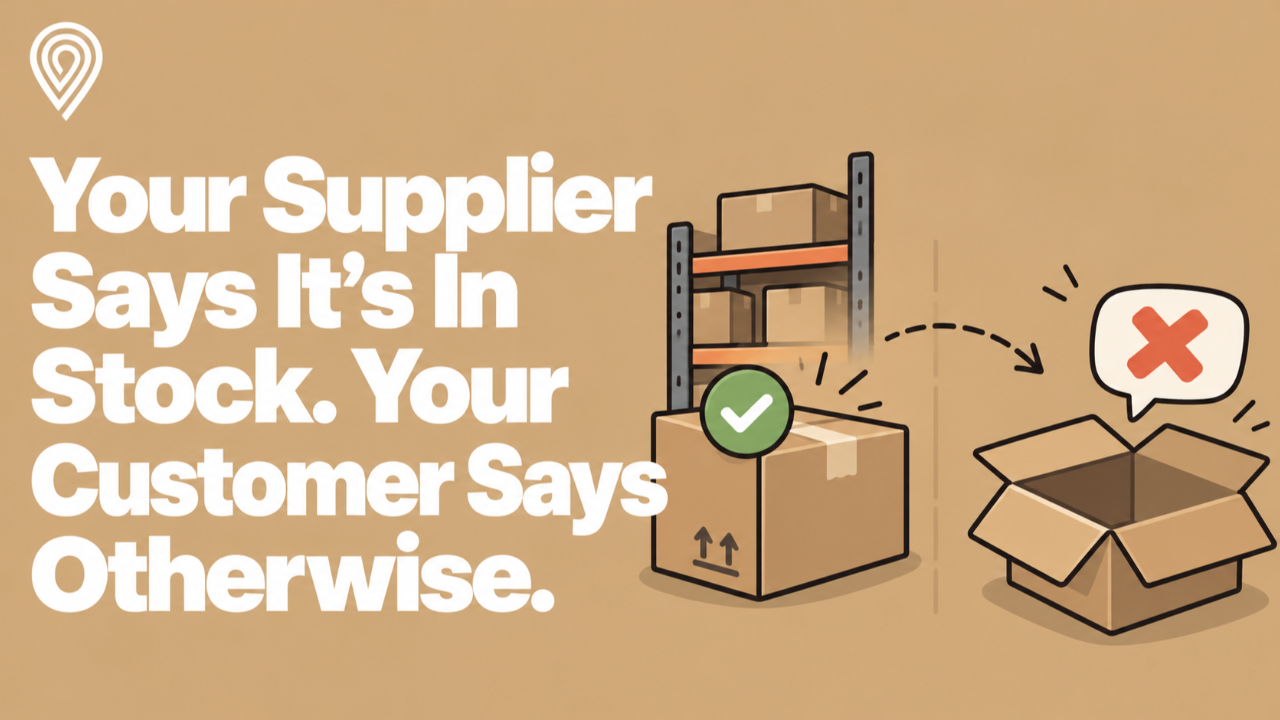
Your Supplier Says It’s In Stock. Your Customer Says Otherwise.
There is a moment every dropshipping store owner eventually learns to hate.
A customer has placed an order. Their payment has gone through. You have already celebrated the sale, paid for the ad click and maybe even started thinking about scaling the product.
Then the supplier replies:
Sorry, this item is out of stock.
Or worse, they do not reply at all.
Maybe the product is technically available, but not in the colour the customer ordered. Maybe the last few units were sold through another marketplace. Maybe the supplier changed the product, discontinued it, ran out of a variation, or has not updated their stock feed for two days.
From your side, it feels like a supplier issue.
From your customer’s side, it looks like your store took their money for something it could not deliver.
That is the inventory problem in dropshipping. It is not just a backend annoyance. It affects your ads, your conversion rate, your refunds, your reputation, your supplier relationships and the long-term health of the store.
A green “In Stock” button is not just information on a product page.
It is a promise.
An “In Stock” Badge Is a Customer Promise
When a customer sees a product listed as available, they make a simple assumption: if they pay now, the business can supply it.
They do not think about supplier feeds, warehouse systems, manual stock checks, product variations or third-party integrations. They do not know that the supplier sells the same item through ten other stores, eBay, Amazon, a wholesale portal and a physical showroom.
They do not care.
They bought it from you.
This is one of the biggest mindset shifts new dropshippers need to make. You are not simply passing traffic to a supplier. You are the retailer in the customer’s eyes.
If an item cannot be supplied after the customer has paid, you need to own the solution.
The ACCC is clear that if a business cannot provide a product or service that a customer has paid for on time, or within a reasonable time, the business must provide a solution. That might mean a confirmed alternative, a realistic back-order option or a refund.
It does not mean making the customer wait while you chase your supplier for an answer.
That is why inventory accuracy matters so much. It protects the customer experience before the problem even starts.
How Stock Problems Actually Happen
Most stock problems are not caused by one supplier deliberately doing the wrong thing.
They happen because dropshipping has a lot of moving parts.
A supplier may have 20 units of a product in the morning. By lunchtime, they may have sold those units through their own website, a marketplace account and several other retailers. Your Shopify store might still show the product as available because the stock feed updates only once every few hours.
A product may be in stock at a supplier level, but the customer’s chosen variation may not be. The black version could be available while the white version has sold out. The large size may be gone while small is still available. The product page might show “In Stock” because the parent product exists, but the exact item the customer wants does not.
Sometimes the product itself changes.
A supplier might update packaging, change the material, remove an accessory, replace one model with another or discontinue a colour without telling every retailer. If your store uses copied product data, you can end up selling something that no longer matches the product page.
Then there is the seasonal problem.
A product may be available most of the year but disappear during the exact period you want to promote it. Camping items sell out before holiday periods. Storage products can spike around moving season. Gift products disappear before Christmas. Fitness products move quickly around New Year. Pet products can sell out after a viral social-media trend.
The supplier is not always doing anything wrong.
But your store still needs a process that protects the customer.
The Most Common Inventory Mistakes
The first mistake is treating every supplier product as equally reliable.
They are not.
Some suppliers have excellent live stock feeds, fast dispatch, good communication and clear variant data. Others rely on spreadsheets, manual updates, delayed emails or stock information that is not connected to their actual warehouse.
You cannot promote both types of supplier in the same way.
The second mistake is advertising a product before confirming its stock depth.
A product might have three units available. That is enough to put it on a product page. It is not enough to build a Facebook or Google campaign around unless you are comfortable pausing the ad almost immediately.
The third mistake is relying on the word “integration.”
A Shopify app connection can be useful. It can save time. It can update products and stock. But it does not automatically make inventory accurate.
Some integrations update once a day. Some update only when the supplier sends new data. Some do not handle bundles properly. Some confuse product variations. Some still require manual checking for important products.
An integration is a tool.
It is not a guarantee.
The fourth mistake is keeping dead products live.
A store can slowly fill with discontinued products, unavailable variants, outdated supplier images and old pricing. This often happens when someone imports a huge catalogue and never reviews it properly.
The store starts to look bigger, but it becomes less reliable.
The fifth mistake is allowing a supplier to substitute products without approval.
A supplier might say they sent a “similar” version because the original was unavailable. That can be fine for a small accessory if the customer agrees first. It can be a major problem if the product is a different model, different size, different colour or missing an important feature.
Never assume a customer will be happy with a substitution because it seems close enough to you.
They paid for a specific item.
Your Supplier Connection Is Not Your Inventory System
A lot of dropshippers want a fully automated business from day one.
That makes sense. Automation is one of the biggest advantages of dropshipping when it is set up properly.
The problem comes when automation replaces basic oversight.
If your store has 3,000 supplier products, you cannot realistically know whether every item is live, available, correctly priced and still accurately described. You might be able to import them. You might be able to display them. But that does not mean you should advertise them.
The better approach is to separate your products into groups.
Your hero products are the products you actively promote. These need the most reliable stock data, the clearest supplier relationship and the best product information.
Your support products are useful add-ons, accessories and complementary products. They may not receive direct paid traffic, but they still need to be available and easy to fulfil.
Your long-tail products are the rest of the catalogue. Some may sell occasionally through organic search, collections or existing customers. These should be reviewed regularly, but they do not need the same level of ad spend or attention as your hero products.
The mistake is trying to treat every product as a potential winner.
A store does not need 2,000 products to look credible.
It needs 20 to 50 products it can confidently sell, deliver and support.
Why a Stockout Costs More Than One Sale
When an item is unavailable after a customer has paid, the damage goes beyond the order value.
You may have already paid for the customer acquisition cost. If you spent A$30 or A$50 on ads to win that sale, that money is gone even if you refund the customer.
You may have payment fees, support costs and supplier administration to deal with. Your team needs to contact the supplier, check whether another variation is available, email the customer, process a refund or organise an alternative.
Then there is the reputation cost.
The customer may leave a bad review. They may tell friends that the store took their money for something that was not available. They may dispute the charge with their bank. They may never return, even if you resolve the issue properly.
A repeat stockout problem can also hurt your advertising.
Google Merchant Center expects product availability, pricing and shipping information to be accurate. If your store frequently advertises products that are unavailable, it can create feed issues and reduce trust in the account. The same applies to customers clicking ads only to discover that the item they want is no longer available.
A product can look successful in Ads Manager while quietly creating a poor customer experience behind the scenes.
That is why stock accuracy needs to be part of the decision to scale a campaign.
Hero Products Need to Earn Their Ad Budget
Before you put serious ad spend behind a product, it should pass a simple test.
Can the supplier reliably confirm stock?
Is the exact variation available?
Does the supplier have enough units to handle a campaign?
Can they dispatch it within the delivery window on your product page?
Do they have a clear process for incorrect products, damages and returns?
Can you contact someone when an order needs urgent attention?
If the answer to those questions is unclear, the product is not ready to be your hero product.
It may still belong in the store. It may sell organically. It may be useful as an accessory. But it should not be the product that receives your paid traffic, email promotions and social-media content.
A good hero product is not only one that gets clicks.
It is one that can survive success.
That means it has enough stock, enough margin, clear supplier communication and a delivery process you understand. It can handle ten orders, then fifty orders, without creating a wave of cancellations.
This is where many stores get caught.
They find a product that starts converting, increase the ad budget, then discover the supplier only had five units left. The campaign looks successful for two days, and then the support problems start.
The smarter move is to ask the supplier about stock depth before scaling. Let them know what you are planning. Ask whether they can handle the projected order volume. Check whether they expect any price changes, stock gaps or dispatch delays.
A supplier who cannot answer those questions may not be the supplier you build your business around.
Build a Simple Inventory Routine
You do not need to spend all day checking supplier portals.
You do need a simple routine.
Each morning, review new orders that have not yet been accepted or fulfilled. If an important order has been sitting for too long, check it before the customer has to ask.
Review the products currently running in paid campaigns. Check stock levels, variations and supplier updates. If stock is getting low, pause or reduce the campaign before it creates a problem.
Each week, look at cancelled orders and refunds. Were they caused by stock? Were customers ordering unavailable variations? Did one supplier create more problems than another?
Each month, review the products that are no longer selling or have not been checked recently. Confirm they are still available, still correctly priced and still described accurately.
You do not need a complicated inventory dashboard to begin.
A simple spreadsheet or internal list can be enough. Track the product name, supplier, stock confidence, dispatch time, return process, ad status and any recurring issue.
The goal is not to create more admin.
The goal is to stop being surprised.
Be Careful With Low-Stock Messaging
Low-stock messaging can help a customer make a decision when it is true.
It can also destroy trust when it is fake.
A countdown timer that resets every day, a “Only 2 Left” badge that appears on every product, or a false scarcity message may create a short-term conversion lift. It also makes the store look like every other generic ecommerce site.
More importantly, misleading availability claims can become a legal and platform problem.
Use low-stock messaging only when the information is accurate and the product is genuinely at risk of selling out.
For most dropshipping stores, it is often better to use more practical availability wording.
For reliable Australian stock, you might say:
In stock and usually dispatched within 1–2 business days.
For products with more variable supplier availability, you might say:
Available to order. Dispatch timing is confirmed after your order is processed.
For a product that has genuinely sold out, do not leave it live with a buy button. Offer a back-in-stock notification, suggest a verified alternative, or clearly state the expected return date if you have one.
A waitlist is useful.
A pile of paid orders you cannot fulfil is not.
What to Do When an Item Is Actually Unavailable
Even with a good system, stockouts will happen occasionally.
The way you handle them matters more than the fact that they happened.
Do not send the customer a long explanation about your supplier, warehouse software or shipping portal. They do not need the background story.
They need a clear answer.
A good message sounds like this:
Hi [Name],
I’m sorry, but the exact [product or variation] you ordered is no longer available from our fulfilment partner. We should have identified this before your order was accepted.You can choose a full refund today, wait for the next confirmed stock date of [date], or choose [specific alternative] if it suits you.
Please let us know what you would prefer. If we do not hear from you by [date], we will process a full refund rather than leave you waiting.
That message does a few things well.
It takes responsibility. It gives the customer real options. It does not pressure them into accepting something else. And it prevents the order from sitting unresolved for days.
Never assume a substitute is acceptable. Never promise a restock date you have not confirmed. Never make a customer feel like they have to fight for their money back.
A problem handled quickly can still leave a customer with a decent impression of the store.
A problem handled badly can lose them forever.
Keep Your Catalogue Smaller and Smarter
A huge catalogue is not always an asset.
It can create more broken links, more outdated products, more stock problems, more pricing issues and more customer confusion.
A focused store is usually easier to run and easier to market.
You can create better product pages. You can test products yourself. You can understand the supplier. You can create useful content. You can identify which variations customers actually want. You can build bundles that make sense.
That is hard to do when the store is filled with thousands of random products from a supplier feed.
Start with the products you know are available.
Build around the suppliers who communicate well.
Use real sales data to decide what deserves more attention.
Then expand slowly.
Dropshipping gives you the ability to test without buying huge amounts of inventory upfront. Use that advantage properly. Test the product, test the supplier and test the customer response before you build the entire business around it.
Final Thoughts
Inventory is not just a supplier issue.
It is one of the biggest promises your store makes.
When a customer sees “In Stock,” they expect you to be able to deliver. If you cannot, the problem is not solved by blaming an app, a warehouse or a supplier. The customer still needs a fast, fair answer from the store they paid.
The best dropshipping stores are not the ones with the biggest catalogues.
They are the ones that know which products are reliable, which suppliers deserve trust, which items can handle paid traffic and which listings need to be removed before they cause problems.
Choose your hero products carefully.
Keep the catalogue under control.
Check stock before scaling.
And when something goes wrong, take ownership quickly.
That is how you turn a dropshipping store from a catalogue of products into a business customers can trust.
OPPORTUNITY ALERT
Ready to get started with your own drop shipping business? Check out all the Australian "Done For You" dropship stores on our marketplace! They are completely set up, optimised, have great reliable Aussie suppliers in place and are 100% ready to start advertising.
